From Burma we flew to Penang, an island just off the North Western coast of Malaysia, to meet David and Duck. we devoured the delicacies on hand there for a couple of days before busing up to Thailand. Compared with the poverty and difficulty of travel in Myanmar, Thailand seemed a land of luxury and easy living. We spent nearly 2 weeks on the beaches of the South and a week in the mountains of the North. At the end of our trip we came back to Bangkok for the 4th time, but it was the first time we'd had a chance to explore it.
Showing posts with label palace. Show all posts
Showing posts with label palace. Show all posts
Tuesday, March 9, 2010

Tuesday, September 22, 2009
Shannon's pictures are here!
Mongolia through Shannon's lens, Part 1
Part 2
Part 3
You can read more about our trip in older posts. It's only 4 more days til we begin our next big adventure! We're not sure how much internet access we'll have, but we'll try to keep this updated with photos and stories of our travels.
Part 2
Part 3
You can read more about our trip in older posts. It's only 4 more days til we begin our next big adventure! We're not sure how much internet access we'll have, but we'll try to keep this updated with photos and stories of our travels.
Thursday, September 3, 2009
Great Gobi Goodness
After the green and the cold and the waterfalls and the lakes of Central Mongolia, we took a southern turn and headed into the Gobi. We knew we'd arrived when we started seeing camel herds instead of herds of horses.

These bactrian variety are enormous, but seem friendlier than the one humpers.
Though there are roads (dirt) in the Gobi, we didn't tend to stick to them as often there. Looking out from the van the terrain appeared flat and even, but there were many small canyons, ditches and ruts to look out for. But despite the difficulty of the landscape, we only got stuck once.

Brian and Ryan made quick work of that ditch.
As you can see, most of the Gobi is not sandy. It's mostly rocky with small shrubs everywhere, getting browner as you go deeper, but surprisingly green on a good year. But there are sandy areas. After a night of camping near a cave full of crystals we went to Kongoryn Els, or the Singing Sand Dunes. This is the movie version of the Gobi, and it's gorgeous.

A neighboring ger with the dunes.

Ewwww.
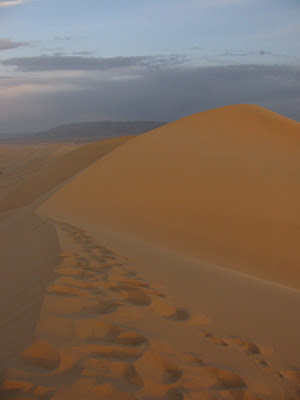
We timed our hour and 45 minute climb up those dunes perfectly. It was sunset when we finally made it. We also discovered why the sands are singing. With each 3 ft step up you take, you slide back 2.5 ft and start a sand slide from about 15 ft ahead of you. The shearing of sand on sand makes a deep reverberating hum that sounds like a train coming on the other side. This of course makes for a very difficult climb, but well worth it.
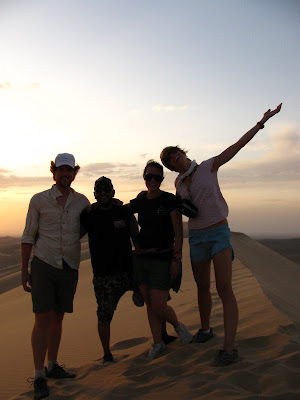
But the best part was coming back down. The sand was so soft and at such a steep angle that you could jump straight out and run down as fast as possible without fear of toppling forward.
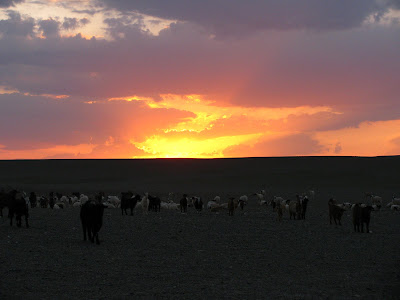
The next day we drove to Bayanzag and got there in time for this spectacular Gobi sunset.
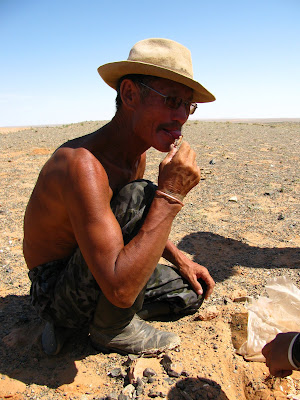
The following morning this guy, our wonderful guide, took us on a camel ride and showed us his secret dinosaur head that he found. The area is famous for dinosaur fossils and has yielded a lot of whole skeletons and the ground is littered with fossil flakes. You can tell the difference between a fossil and regular bone or stone by putting them to your tongue - the fossil will stick (albeit usually only on one facet of the surface) but the others won't. The guide is demonstrating with a fleck from the skull he showed us.
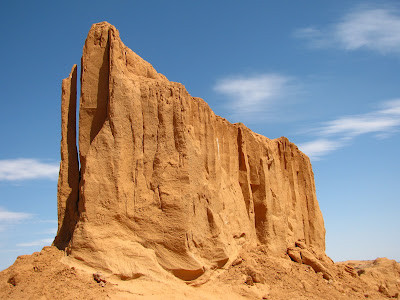
This rock formation is condensed sand, not really rock. We rode by it on our camels.

I love my camel.
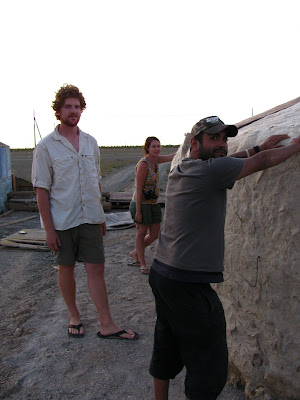 They're holding up a layer of felt as it gets tied into place.
Next stop was the Painted Desert. The colors were amazing and the whole thing made me want a big bowl of sherbet.

After the Painted Desert we went to Ice Canyon (Yolyn Am) which was gorgeous (oh the puns) but devoid of any and all ice though it wasn't for lack of looking.

And our last night out in the wilderness Ikman, our driver, took us to a beautiful, mountain wrapped campsite where we built our very own poo fire and had one last look at the starscape before our final drive back to UB.

Scenery near our campsite.
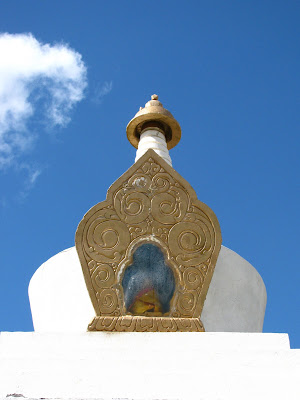
A stupa around the mountain were we camped out.
Back in UB we ate delicious Mexican food and praised something for the change-up from mutton meals, we went to a market where we found amazing, weathered old Buddhist relics, and headed to the main temple in town and the Winter Palace of the Bogd Khan, now a museum full of fantastic Buddhist art and a strange emporium of the bizarre gifts the Khan (King) was given during his life.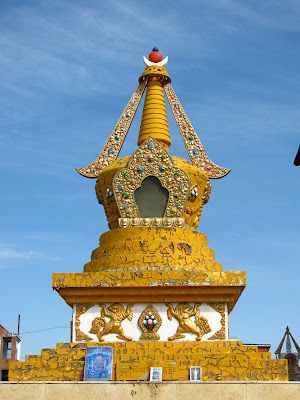
A stupa at the temple.
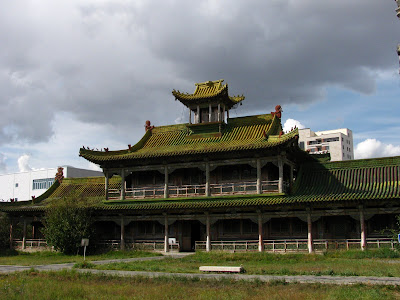 One of the halls in the Winter Palace.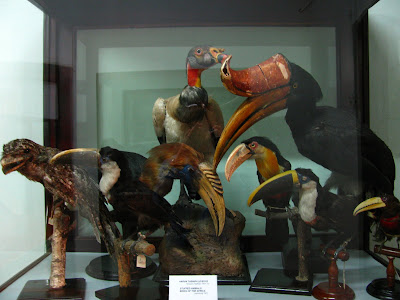
African birds that were once a living part of the Khan's zoo. Look at the bill on that one farthest left.
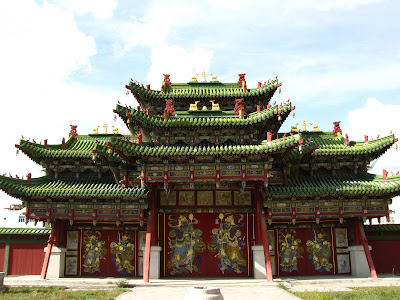 It was wonderful.
It was certainly the most epic trip I've ever done, and I would absolutely recommend it to anyone who can spare the time to go. The landscapes were breathtaking, but the best part of Mongolia is by far the people and the incredible way of life they've preserved for hundreds, maybe even a thousand years. I think all 4 of us would highly recommend UB Guesthouse (Bobbi even came to the hospital to check on Shannon when she got food poisoning) www.ubguest.com, but if I had it to do over again I would want to spend more nights with families that aren't used to hosting tourists, like we did around the lake.
Brian's working on making videos of all our short videos and Shannon's pictures are coming soon. We're down to 14 more teaching days before then end and life's getting hectic in order to prepare for our upcoming trip and the move home. If you have a job to offer us when we get back, please let us know because we've got 6 months to bum off parents and burn through savings and generally be drains on society until we get one.
Tuesday, February 3, 2009
Seoul trip and ice fish, a winter wandering
Last Thursday we took a 4 hour bus ride to Seoul to see what it had to offer. We got there in the evening and checked in to our hostel where the nameless owner kept laughing hysterically (and what a laugh!) and play punching Brian in the belly. It was hilarious in that somewhat awkward but still absurd enough to be really funny kind of way. But we didn't stay long, we were out on the streets as soon as Mr. Laugh Attack had helped us figure out how to get to Inje on Saturday.


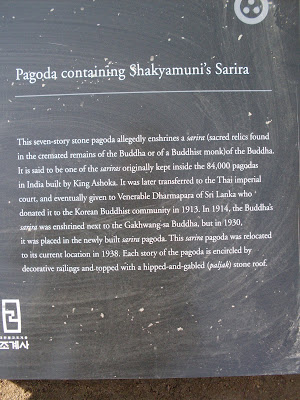
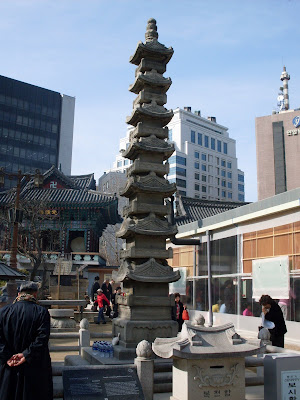
From Jongmyo we walked along until we found Jogyesa. This is the headquarters of the Jogye sect of Buddhism (the largest in Korea, emphasizes Zen style meditation) and it houses a 7 tiered pagoda that is rumored to contain some of the Sariras of Guatama Buddha Himself. As Mi Yeun once explained it to me, a sarira is like a crystal, it's not bone or another anatomical body part, but it's found in the ashes of a cremated Buddhist and in many vegetarians. I've never heard of this before coming to S. Korea, but now I want to google it. Supposedly, the more devout the Buddhist, the more sariras in their remains. Here's the placard explaining the pagoda.
And the actual pagoda.
After a quick lunch we were off to Changdeokgung, another of the Joseon palaces. The buildings in all of Seoul's palaces aren't much more than 200 years old because most of them have burned at various times. Many were burned during the Japanese occupation of Korea, so most are reconstructed. This is the lotus pavilion and universe pond in the royal gardens.

That night we went out with a vague idea to see the South Gate (Seoul was once a walled city) and the Seoul Tower. But when we found the South Gate it was completely enclosed in a construction wall for rebuilding. Apparently it burned down along with part of the market that flanks it sometime in the recent past. So no gate, but into the market we went and we found a little alley of soju tents. After seeing what they all had to offer, we settled on one particularly delicious looking tent. I told the woman there that we didn't eat meat, so she pulled me up to her display and showed me all the options. I said yes. So we ended up with ALL the non-meat options. It was delicious, but an expensive mistake. We had Ginkgo seeds, mushrooms, noodles, shrimp, octopus, and eel along with soju and cider (sprite). We may have been ripped off, but it was still worth it, and the two old Korean men beside us loved us and were so friendly and fun. We ended up skipping the tower too, because we'd just seen Busan tower recently and night views of cities are similar enough that we didn't feel we were missing out on anything. Somehow there are no photos of this night, except for this one from the subway. It's for you Bart, the only vinyl shop we've seen so far, but it extended for half a block in 4 directions. You could have played around in there for hours.

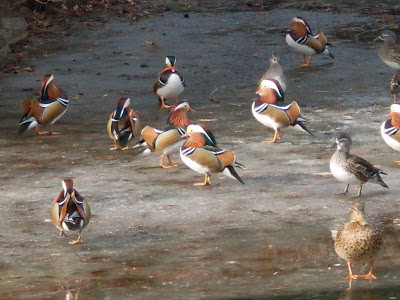
Back at the hostel we shared some soju with Mr. Laughing Gas and his friends before calling it a night. But the next day we were up early to see all the sites. Our first stop was the palace Changyeongung, a small-ish palace with a large garden from the Joseon Dynasty. The Joseon Dynasty was the first to call Seoul the capital of Korea, and it was the last of the Korean monarchies; the last surviving royal family member died in 1989, but Joseon rule was over long before that. Check out the slide show for more photos, but here are some Korean ducks on the frozen pond.
From the first palace we stumbled on Jongmyo shrine, which is where all the spirit tablets of past Joseon kings and queens are kept. Joseon period was when Confucianism was at its height in Korea, and this shrine is built in the unadorned Confuscian style with the purpose of performing Confucian ancestor rituals. Religion today in S. Korea is a hodgepodge of Buddhism (Shilla Dynasty), Confucianism (Joseon), Shamanism (before religion from other parts of the world trickled over), and Christianity. Everyone pays homage to their ancestors at 3 different times during the year (Confucianism), they usually visit Buddhist temples every now and then, and many people make small shrines near the seaside or mountains to pray for various aids (shamanism). Here's a view of Jongmyo shrine.

From the first palace we stumbled on Jongmyo shrine, which is where all the spirit tablets of past Joseon kings and queens are kept. Joseon period was when Confucianism was at its height in Korea, and this shrine is built in the unadorned Confuscian style with the purpose of performing Confucian ancestor rituals. Religion today in S. Korea is a hodgepodge of Buddhism (Shilla Dynasty), Confucianism (Joseon), Shamanism (before religion from other parts of the world trickled over), and Christianity. Everyone pays homage to their ancestors at 3 different times during the year (Confucianism), they usually visit Buddhist temples every now and then, and many people make small shrines near the seaside or mountains to pray for various aids (shamanism). Here's a view of Jongmyo shrine.

From Jongmyo we walked along until we found Jogyesa. This is the headquarters of the Jogye sect of Buddhism (the largest in Korea, emphasizes Zen style meditation) and it houses a 7 tiered pagoda that is rumored to contain some of the Sariras of Guatama Buddha Himself. As Mi Yeun once explained it to me, a sarira is like a crystal, it's not bone or another anatomical body part, but it's found in the ashes of a cremated Buddhist and in many vegetarians. I've never heard of this before coming to S. Korea, but now I want to google it. Supposedly, the more devout the Buddhist, the more sariras in their remains. Here's the placard explaining the pagoda.

And the actual pagoda.

After a quick lunch we were off to Changdeokgung, another of the Joseon palaces. The buildings in all of Seoul's palaces aren't much more than 200 years old because most of them have burned at various times. Many were burned during the Japanese occupation of Korea, so most are reconstructed. This is the lotus pavilion and universe pond in the royal gardens.

After that last palace we were wiped, so we walked to Insadong, the famous antiques and art galleries street where many traditional Korean goods are sold. There we went to Yetchapjip, an old tea house serving traditional Korean teas in a lovely old building packed with songbirds, antiques, and Korean decor. We eventually headed to a restaurant for drinks, and another for a dinner of nakji (octopus) and rice before heading back to the hostel because it was an early morning the next day.
The next day we got up early to catch a bus to Inje for the Ice fish Festival. Ice fish here means smelt, but that sounds less romantic. In Korean, smelt is bingho, and at this festival about a thousand people, plus galloping horses, snow mobiles, and tents, go out on the ice sheet of a frozen river, poke it full of holes, and use a flyswatter-like device baited with meal worms to catch these little fishies. But that's not all it has to offer, there's also ice soccer, ice sculptures, human bowling, human curling, ice sledding, and rides.
The next day we got up early to catch a bus to Inje for the Ice fish Festival. Ice fish here means smelt, but that sounds less romantic. In Korean, smelt is bingho, and at this festival about a thousand people, plus galloping horses, snow mobiles, and tents, go out on the ice sheet of a frozen river, poke it full of holes, and use a flyswatter-like device baited with meal worms to catch these little fishies. But that's not all it has to offer, there's also ice soccer, ice sculptures, human bowling, human curling, ice sledding, and rides.
When we arrived it was much warmer than usual (I still needed seven layers, couldn't move my shoulders all day) so the snow had mostly melted but the ice sheet was intact. Without the snow it wasn't the wintry wonderland I'd envisioned, but it made the day much more fun in terms of being able to handle being on an ice sheet for 6 hours. First we cruised around, watched a game of ice soccer, saw the melted snow hill where human bowling would have been, checked out the ice sculptures and the fair grounds. Then we got some help finding lodgings for the night (that we ended up not using), and then settled into ice fish. We rented an ice sled to sit on, got some snacks and soju plus our fishing gear, found a hole somebody'd abandoned, and we were set. We had a lot of fun, and even saw some action down on our hooks, but we didn't catch anything. When we got too cold sitting, we took advantage of the fact that our chair was an ice sled. Observe.
In this next one you get to see the snow mobile rides and a galloping horse.
After we were thoroughly frozen we found a warm tent that served these mystical Icefish we saw everyone else catching. Now, there's more than one way to eat a smelt. The most common ways are fried, sauteed, and live. We tried the first and last of these. Fried was great, very easy, very dead. Live...Brian had more luck than I did, but his video's sideways.
Next I tried, but I was too timid. The taste was actually very good. No bones or guts gushing out, just fresh fish taste. You could feel the hard fins though, and it was surprisingly crunchy.
After we were thoroughly frozen we found a warm tent that served these mystical Icefish we saw everyone else catching. Now, there's more than one way to eat a smelt. The most common ways are fried, sauteed, and live. We tried the first and last of these. Fried was great, very easy, very dead. Live...Brian had more luck than I did, but his video's sideways.
Next I tried, but I was too timid. The taste was actually very good. No bones or guts gushing out, just fresh fish taste. You could feel the hard fins though, and it was surprisingly crunchy.
On our way back to town from the festival grounds we got a ride in a cop car. We asked a group of them where the bus stop was, and one of them told us to hop in and he'd take us. Restored my faith in the profession a bit. He was so friendly and kind. He dropped us at the bus station, but the bus to our lodging didn't leave for 2 hours, and it only takes 3 to get back to Seoul and a bus was leaving in 30 minutes for that trip. So we decided to head back to Zen hostel again. But when the bus came, it pulled up for about 30 seconds, and we were looking at it and our tickets and trying to decide when it left again. We thought it must not have been our bus, but the ticket window guy came running out chasing the bus and motioning for us to follow so Brian sprinted out in front of it to wave it down. Without further incident we made it back to Seoul.
Sunday, our last day in Seoul, we went to see some museums we'd missed on our first big excursion. We went to the Museum of Korean Buddhist Art, which was small but enlightening. They had a display of Burmese Buddhist embroidery in the temporary exhibit that was really beautiful and so detailed. Then we were off to see the National Folk Museum, which displays all sorts of anthropological artifacts and Korean antiques with explanations of traditional life in Korea. Also enlightening. Afterwards we had tea again, I had ginger tea, which is one of the Korean traditional varieties, and it was what I've always wanted tea to be. I can't wait to discover tea houses in Busan.
We caught a bus back to Busan that Sunday night in time for a cheese making, pizza baking, homebrew drinking extravaganza with Ryan and Shannon ( who we hadn't seen since we left for the Philippines) and David and Duck. It was a great reunion and perfect start to our last week of vacation. School starts back this Friday and we'll all have new coteachers. I'm looking forward to it, but I'll miss all the free time for adventuring.
Subscribe to:
Posts (Atom)